CATEGORIES
START HERE
SURF IN MOROCCO
Small-group surf stays
North-Central Morocco
Surf Progression & Performance: Turning Nerves Into Better Surfing
If you’ve ever paddled out when the waves were bigger than usual, more crowded, or more intense than your comfort zone, you know the feeling.
Breathing gets shallow. Thoughts speed up. Your heart rate jumps before you even turn for a wave.
For many surfers, that moment becomes a limit. They hesitate. They pull back. They surf below their ability.
Most people label that feeling as fear or weakness. I see it differently.
That feeling is raw energy. And when you learn how to work with it, it becomes one of the biggest drivers of surf progression and performance.
Why Pressure Shows Up Right Before You Progress
Surf progression rarely happens in comfort.
It happens when conditions challenge you. Bigger waves, heavier takeoffs, tighter sections, more eyes on the lineup. Whether or not you compete, surfing eventually puts you in situations where pressure is real.
That pressure isn’t a sign you’re not ready.
It’s a sign you’re stepping into new territory.
The problem isn’t the nerves themselves. It’s how most surfers interpret them.
Why Nerves Can Improve Surf Performance
In sports psychology, there’s a well-known concept often referred to as the “Inverted U” principle. In simple terms, performance improves with arousal up to a point, then drops if arousal becomes overwhelming.
Too little activation and you surf flat. Too much and you lose clarity.
Right in the middle is the sweet spot. That’s where focus sharpens, reactions get faster, and decisions become instinctive.
Surfing lives in that zone.
The ancient Stoics understood this long before modern science. Epictetus said it clearly: people aren’t disturbed by events, but by how they interpret them.
Your nerves are not the problem. Your story about them is.
A Surfer Case Study: From Training Hero to Performance Under Pressure
One of my clients was a young surfer competing at national level. In free surf and training sessions, he looked effortless. Flow, confidence, good decisions.
Then the heat started.
As soon as the horn blew, his surfing changed. He rushed waves, hesitated on takeoffs, and surfed defensively.
Not because he lacked skill, but because pressure hijacked his system.
We didn’t try to eliminate his nerves. We built a routine to use them.
Within two competitions, his results changed dramatically. Same surfer. Same waves. Different mental setup.
That’s when surf progression becomes real.
A Simple 4-Part Routine to Improve Surf Performance Under Pressure
1. Use Breathing to Regain Control
Before paddling out or sitting outside, your heart rate often spikes unnecessarily.
Slow nasal breathing brings it back under control.
Breathe in for four seconds.
Breathe out for six seconds.
Two minutes is enough to calm your nervous system and clear mental noise.
You don’t lose aggression. You gain clarity.
2. Focus Only on the First Wave
One of the biggest performance killers in surfing is thinking too far ahead.
Instead of imagining the whole session, the size, the crowd, or how you “should” surf, narrow your focus.
Visualize just the first wave you want to take. Where you sit. When you turn. How you paddle.
This reduces overwhelm and makes action automatic.
Surf progression happens wave by wave, not session by session.
3. Anchor Confidence Through Movement
Surfing is physical. Your mind follows your body.
Create a small physical ritual that signals intention. It can be simple. Two strong paddle strokes. Shaking out your shoulders. Adjusting your leash deliberately.
My surfer client took two committed paddles before every first wave. That movement became his switch from thinking to doing.
Your body learns faster than your mind.
4. Reframe the Inner Dialogue
The words you use internally matter more than you think.
Instead of telling yourself “I’m nervous” or “this is heavy,” change the label.
“I’m activated.”
“I’m ready.”
“This matters.”
Research shows that reframing anxiety as excitement or readiness improves performance under pressure. The sensation stays the same. The outcome changes.
How I Use This for My Own Surf Progression
I still feel nerves when I push my own boundaries. Bigger days. New breaks. Heavier conditions.
My routine is simple.
I move my body before paddling out. I slow my breathing. And I focus on one idea: surf the wave in front of me, not the story in my head.
That shift alone changes how I surf.
When focus moves from proving something to engaging with the wave, performance follows naturally.
Why This Routine Works for Surf Progression
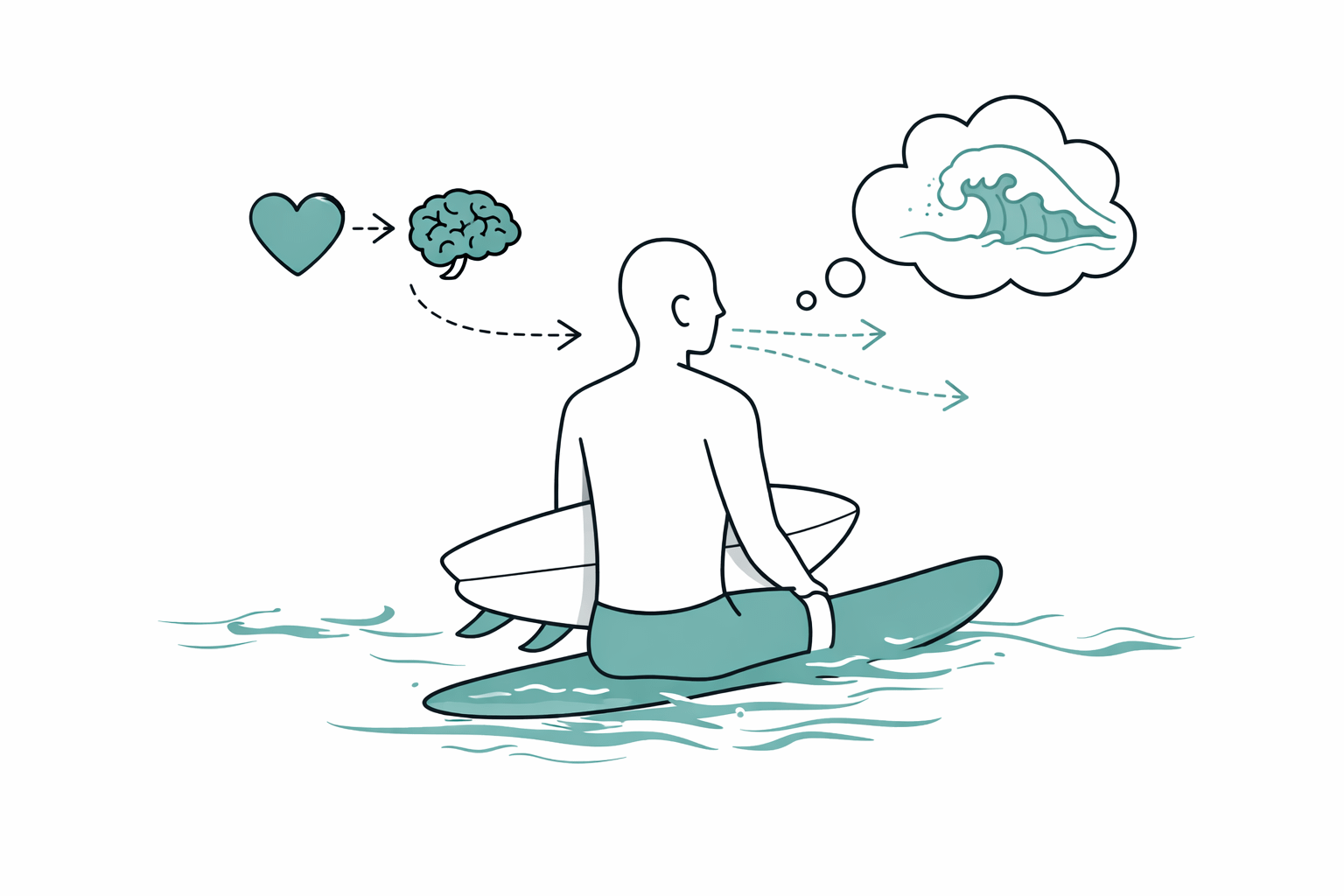
This approach works because it aligns physiology and psychology.
Breathing regulates the nervous system.
Visualization primes movement patterns.
Physical anchors create confidence.
Reframing reshapes perception.
Together, they create a mental environment where pressure sharpens performance instead of blocking it.
A Final Reminder for Surfers Who Want to Progress
Marcus Aurelius wrote that you have control over your mind, not external events.
You can’t control the size of the set, the crowd, or how others surf. You can control how you show up.
And that’s often the difference between staying in your comfort zone and stepping beyond it.
Your Next Step
Don’t wait for a competition to test this.
Use this routine the next time you paddle out in waves that feel slightly uncomfortable. Bigger, heavier, or more exposed than usual.
That’s where real surf progression begins.
About the Author: Coach Dris