CATEGORIES
START HERE
SURF IN MOROCCO
Small-group surf stays
North-Central Morocco
Surf Fitness: Why Most Surf Trips Fail After Day Two (And How to Fix It)
Surf fitness is one of the most underestimated parts of surfing.
Over the years, in surf houses, surf camps, and surf trips around the world, I’ve seen the same pattern repeat itself again and again.
People arrive motivated. They’re excited. They’ve booked six or seven days of surfing. They want to progress, catch more waves, and finally feel confident in the water.
Then day two hits.
Arms are destroyed. Shoulders burn. Paddling feels impossible. Lower back feels tight. Pop-ups become sloppy. By day three, they’re exhausted, frustrated, and dependent on the coach to push them into waves.
At that point, the surf trip they paid good money for becomes survival instead of progression.
And the reason is almost always the same: lack of surf fitness.
Why Paddling Breaks Most Surfers First
Paddling is what exposes poor surf conditioning the fastest.
Surfing looks relaxed from the beach, but paddling is a repetitive, demanding movement that most people never train for. Even fit people who run, lift weights, or play other sports get shocked by how fast their arms give up.
After two days of paddling, many surfers simply can’t lift their arms anymore.
That’s when massages get booked, rest days are forced, and frustration sets in. Not because the waves are bad, but because the body can’t keep up with the intention.
Surf fitness isn’t about being ripped.
It’s about being able to repeat effort without breaking down.
The Hidden Cost of Poor Surf Fitness
Here’s the frustrating part.
You travel far.
You take time off work.
You invest money in a surf destination.
And then your body limits you.
Instead of catching more waves each day, you catch fewer. Instead of progressing, you regress. Instead of enjoying the experience, you start counting how sore you are.
This is avoidable.
And I learned that lesson myself.
How I Learned the Importance of Surf Fitness
There was a period when I lived in Sweden. Surf access was limited, and I could only surf a couple of times per year, usually during holidays.
One surf trip in particular meant a lot to me. Ten days in the Mentawai Islands back in 2012. Expensive, remote, and important enough that I didn’t want to waste a single session.
I hadn’t surfed for months. I knew that if I showed up unprepared, I’d be destroyed after two days.
So I called a friend who was a sports teacher and asked one simple question:
“How do I not get exhausted paddling?”
His answer was simple.
Go swim. Crawl style.
Why Swimming Is One of the Best Surf Fitness Tools
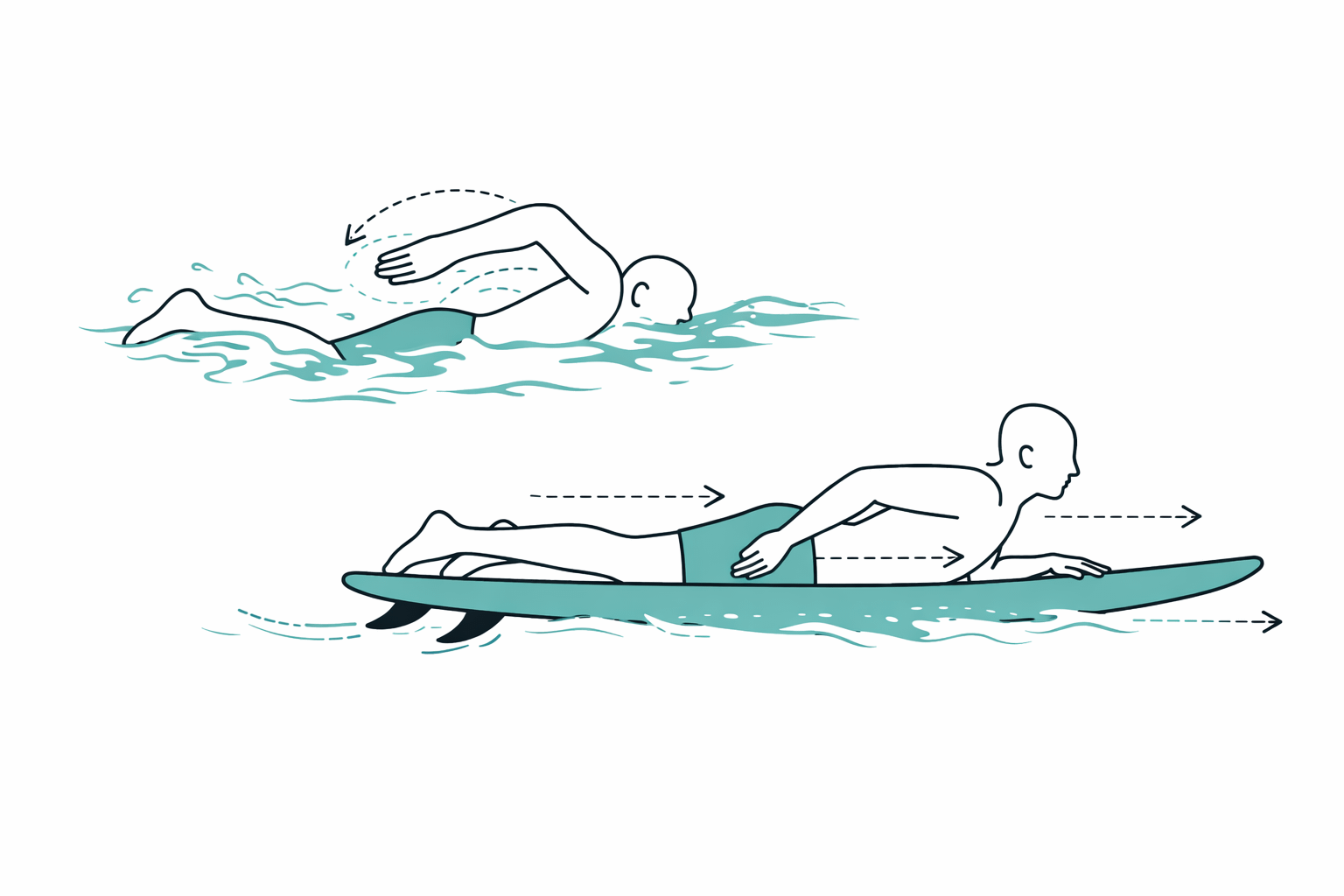
Swimming crawl mimics paddling better than almost anything else.
It builds shoulder endurance, breathing control, and rhythm. It’s low impact and brutally effective if done consistently.
For weeks before that trip, I swam 3,000 to 4,000 meters twice per week. Nothing fancy. Just volume and consistency.
I also boxed, ran, and trained explosiveness. But swimming was the foundation.
When I arrived on that trip, the difference was massive. I could paddle longer, recover faster, and actually enjoy consecutive surf days instead of surviving them.
That’s when surf fitness stopped being optional for me.
What Surf Fitness Really Means (Without the Noise)
There is a lot of noise around surf fitness. Influencers, complicated programs, endless variations.
In reality, surf fitness comes down to three things.
Explosive power.
Mobility.
Endurance.
That’s it.
If you cover those three bases, you’ll outperform most surfers who just “surf when they can.”
Endurance: The Base of Surf Fitness
Endurance is what allows you to paddle session after session without falling apart.
The simplest and most effective way to build it is zone two cardio. Slow, steady work where you can still breathe comfortably and hold a conversation.
Running, cycling, swimming. Two sessions per week. About 90 minutes total.
To complement that, you need short bursts of high intensity. This mimics paddling hard to catch a wave or escape a set.
Intervals work best. Short, hard efforts followed by controlled recovery. Ten minutes is enough if done properly.
This combination builds real surf endurance, not just gym stamina.
Mobility: The Injury Insurance
Mobility is not about being flexible like a yogi.
It’s about having enough range of motion to move safely under load.
Most surf injuries come from stiffness combined with force.
Shoulders need to move freely in all directions.
Hips need to open, rotate, and squat deeply.
Lower back needs support from strong glutes and core.
If something feels stiff, it’s not a signal to avoid it. It’s a signal to work on it.
Simple shoulder circles, deep squats, and hip mobility drills go a long way when done consistently.
Strength: The Minimum You Actually Need
Surfing doesn’t require endless exercises. It requires a few fundamental movement patterns done well.
You should be able to lift something from the floor safely.
You should be able to squat with control.
You should be able to press weight overhead.
Those movements build the lower back, glutes, hips, shoulders, and core. The exact muscles you rely on for paddling, pop-ups, and stability on the board.
Add some pushing work for chest and triceps, and you’re covered.
Everything else is optional.
Surf Fitness Is Also Longevity Training
This matters even more if you start surfing in your 30s, late 30s, or beyond.
Surf fitness isn’t just about performance. It’s about staying pain-free and surfing longer.
Being able to lift, squat, press, move your shoulders freely, and maintain endurance is not just surfing preparation. It’s life preparation.
How Much Surf Fitness Is Enough?
If you live far from the ocean and can’t surf regularly, six to eight weeks of focused surf fitness before a trip can completely change your experience.
If you live near waves and surf often, this training still makes you stronger, faster, and more confident in the water.
You’ll paddle more.
Catch more waves.
Progress faster.
And most importantly, you’ll enjoy surfing more.
Final Takeaway
Surf fitness is not optional if you want to make the most of your surf time.
You don’t need complexity.
You don’t need trends.
You need preparation.
Do the basics consistently, and your surf trips stop breaking you after day two.
They start delivering what you actually came for.
About the Author: Coach Dris